
IPv4 Vs IPv6 -- What's the difference between the two Protocols?

Are you confused by the difference between IPv4 and IPv6?
IP, an abbreviation that means IP. It is an abbreviation that stands fornternet IP. It is an abbreviation for Internet Protocolrotocol which is a protocol for devices and computers that connect through networks. Similar to what the "v" is in the name indicates There are two kinds that make up Internet Protocol: IPv4 and IPv6.
In this blog , we'll go over the essential information you must be aware of to comprehend the differences of IPv4 as well as IPv6. We'll talk about:
Do you prefer to watch instead of watching the Video version?
What exactly is what exactly is Internet Protocol (IP)?
Internet Protocol (IP) is a set of established rules that aid in routing data packets to ensure that the data can move through networks and be delivered to its intended destination.
If a computer attempts to transfer data, it's broken into smaller bits which are known as packets. To make sure that the packets reach the proper destination, every packet is preceded by information on the IP.
The IP address you are most familiar with will appear something like this:
32.253.431.175
In assigning every device with an IP address, it will be in a position to efficiently route those data packets to ensure they make them to the correct location.
What do you mean by IPv4?
Although it's not that "4" that is mentioned in the name, IPv4 is in fact the very first version of IP to be utilized. It first came out around 1983, and even until today, it's the most widely used that can identify devices on the network.
IPv4 is a type of address. IPv4 is a 32 bit address which is the form that you're probably familiar with when talking about "IP address". The 32-bit address area offers around 4.3 million unique IP addresses but some IP blocks are only available to certain applications.
Here's an example of an IPv4 address:
32.253.431.175
What exactly does it mean to be IPv6?
IPv6 is a newer version of IP. IPv6 is the most recent version of IP that uses 128 bits to format addresses that include numerals as well as letters. Here's an example of an IPv6 address:
3002:0bd6:0000:0000:0000:ee00:0033:6778
What is the reason for us to need this New Version of IP?
If you're in this situation, you might be wondering why IPv6 is to begin with.
While the 4.3 billion possibilities for IP addresses from IPv4 might seem like a lotof IP addresses, there is an urgent need for lots of IP addresses!
There are many individuals around the globe with numerous gadgets. The problem is becoming more severe because of the rising popularity of IoT devices (Internet of Things) and sensors, as they greatly expand the variety of devices that are connected.
In simple terms, our planet didn't have exclusive IPv4 addresses. This is one of the main reasons why we needed IPv6.
Additionally, there are other, less technical, and more nitty-gritty causes but let's clear them and out of the way.
What is the difference between IPv4 in comparison to IPv6?
Now let's look at the difference in IPv4 in comparison to IPv6.
One of the most obvious variations that is the most pertinent to everyday people, is the differences between the types of formats:
Do you want to know the steps we took to boost the volume of our business by over 1000 percent?
Join more than 20,000 other users to receive our weekly newsletter each week with insider WordPress guidance!
- IPv4 utilizes a 32-bit address
- IPv6 makes use of an address that is 128 bytes
While not going into the mathematics (we'll let that for the next part) it signifies IPv6 offers IPv6 gives 1,028 additional amount of addresses as IPv4 is able to eliminate the "running out of address" issue (at at least in the not too distant future).
IPv6 could also be an alphanumeric number that is separated by colons. IPv4 is simply numeric and separated by spaces. Here's an example for each of them:
- IPv4 -
32.253.431.175 - IPv6 -
3002:0bd6:0000:0000:0000:ee00:0033:6778
There are also some technical distinctions in IPv4 as well as IPv6 although those who don't are developers do not necessarily require to know about these. The most significant technological differences include:
- IPv6 is equipped with embedded Quality of Service (QoS).
- IPv6 is a layer of protection that protects networks (IPsec).
- IPv6 provides a solution for Network Address Translation (NAT) and permits end-to end connection at the IP layer.
- Multicasting is among the standards for IPv6 however it's not supported in IPv4. IPv4. Multicasting allows the transmission of the data packet to several destinations at the same time with the same.
- IPv6 contains larger headers of packets (about two times as big than IPv4).
How many addresses are contained in IPv4 when compared with IPv6?
Similar to IPv4, IPv6 can support more than 1,028 IP addresses than IPv4.
IPv4 is able to support approximately 4.29 billion IP addresses.
IPv6 is, however, in contrast, supports...well, the easiest method of writing it's 2128 distinct addresses. If you're interested in the exact number, here's how many unique addresses IPv6 offers: 340,282,366,920,938,463,463,374,607,431,768,211,456
This means that we've got quite a long way ahead of us before we're out of IPv6 addresses!
Is there a distinction there is a difference between IPv4 and IPv6 speed? Which one is faster?
In the end, there's no distinction between IPv4 when compared with IPv6 speed. There is evidence that IPv6 may be slightly quicker in certain situations.
Concerning the "no difference" aspect, Sucuri ran a study of sites that were equipped to work with both IPv4 in addition to IPv6 and observed that there was basically no any difference in the websites they examined.
But, it is also feasible to gather evidence to prove that IPv6 is quicker. As an example, Facebook's Engineering blog announced that "We've observed that using IPv6 to access Facebook is up to 10 percent faster as IPv6".
One reason IPv6 could be faster is due to the fact that it does not spend time in Network Address Translation (NAT). But, IPv6 also has larger headers inside the packet, which means it could be slower in some scenarios.
Are IPv4 and IPv6 more popular?
Although the numbers are changing in the direction that IPv6 growing in popularity IPv4 remains the most popular Internet Protocol.
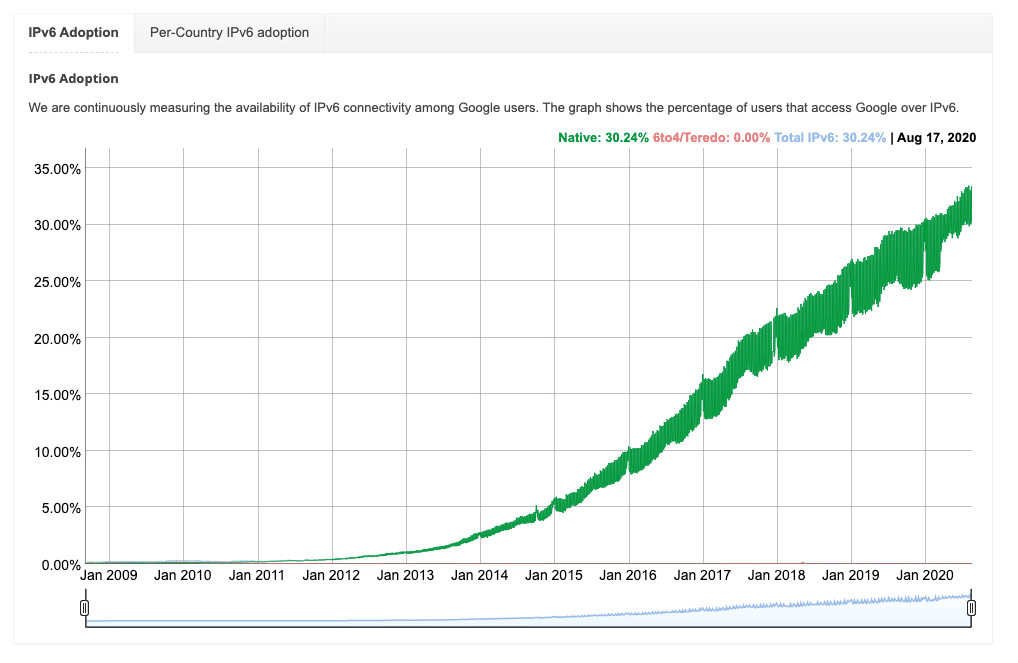
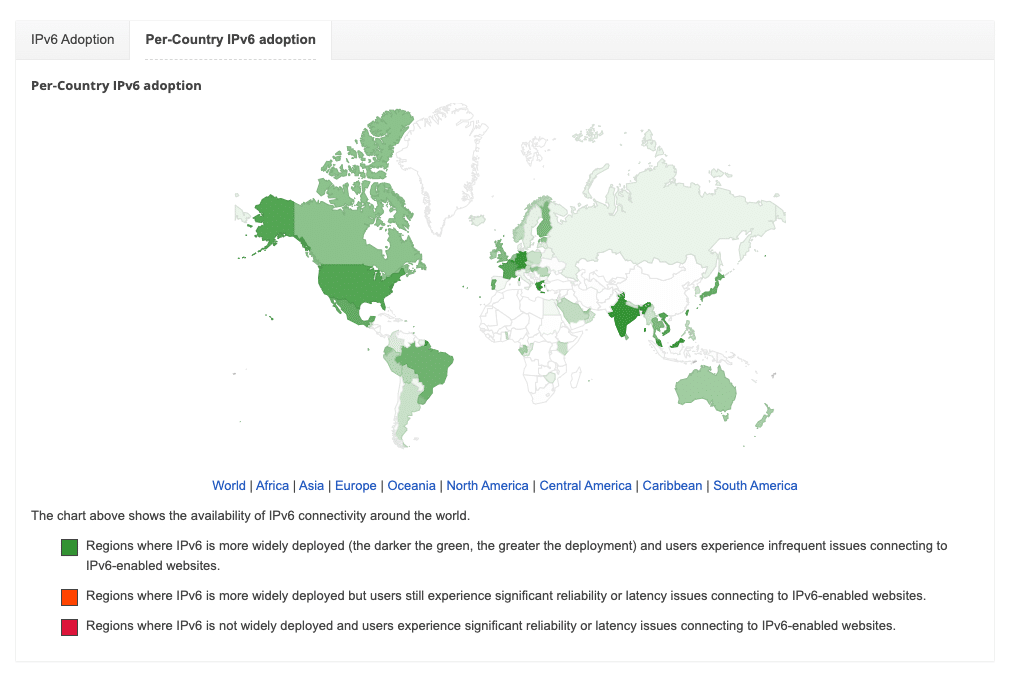
Google keeps public data about IPv6 connectivity of Google users across the globe. These figures are the proportion of traffic to Google sites that have IPv6 but not IPv4.
Worldwide, IPv6 has around ~32 percent availability. There are however huge distinctions between different countries. As an example that the USA is home to more than 41 percent IPv6 use, whereas the UK has around 30 percent usage, and Spain only has 2.5 percent of usage.
Which Internet Protocol Version Does Use?
However, IPv6 support is on Google Cloud's radar, but it may change in the future. It's not yet a time frame to determine the date Google Cloud will add IPv6 support.
Summary
The Internet Protocol (IP) helps to transfer information across networks. For this reason each device is assigned an IP address.
IPv4 is the initial version of IPv4 that first came out in 1983. Its 32-bit format can only support ~4.3 billion unique addresses, which doesn't accommodate the requirements of the modern globe.
In order to address the problem of not having unique IPv4 addresses (and to implement technological improvements), IPv6 was created. IPv6 uses the 128-bit format used for address formats which allows 3.4 10 38 distinct IP addresses.
In the majority of cases, this is the only aspect you need to learn regarding IPv6. IPv6 is a distinct format and has a lot more distinctive IP addresses than IPv4.
Reduce time, money and enhance site performance:
- Support and assistance 24 hours a day from WordPress experts in hosting, on call 24/7.
- Cloudflare Enterprise integration.
- Global reach with 29 data centers around the globe.
- Optimization through the integrated Application for Performance Monitoring.
Tags
Recommended for you

8 Top MAMP Alternatives to consider in 2022

15 Google Drive Alternatives You Need to think about

An in-depth guide on how to design and personalize a WordPress Menu
This post was posted on here